
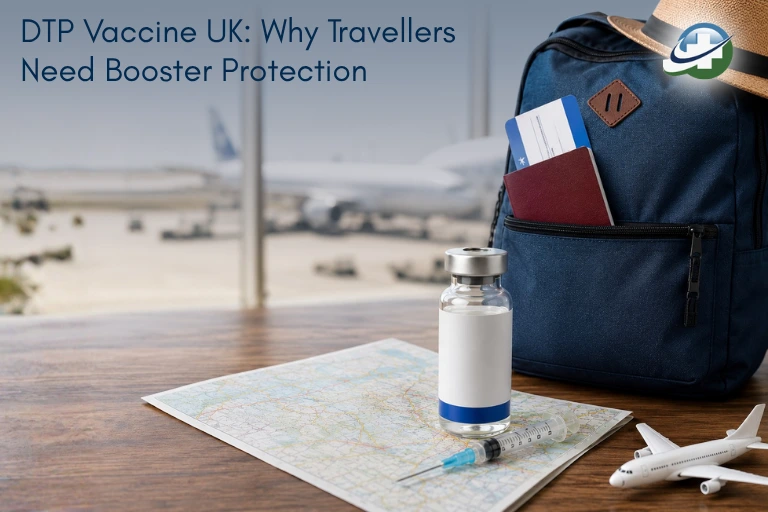
If you had all your childhood jabs and assume you’re covered for life, this is worth reading before your next trip abroad. The DTP vaccine protects against three serious diseases: diphtheria, tetanus, and pertussis (whooping cough). But here’s what many UK adults don’t realize: that protection wears off. And if your last booster was your teenage school jab, it may no longer be doing its job.
This guide covers everything you need to know about the DTP vaccine in the UK, why travellers specifically need to pay attention, and how to get up to date quickly and easily.
What Is the DTP Vaccine?
The DTP vaccine is a combined injection that protects against three bacterial infections:
Diphtheria is a serious throat and airway infection spread through coughing and sneezing. It can cause breathing difficulties, heart damage, and nerve damage. Death occurs in 5 to 10 per cent of serious cases involving breathing problems. Though rare in the UK now, it has not gone away globally.
Tetanus is caused by bacteria found in soil, dust, and animal waste. It enters the body through cuts or wounds and causes severe muscle spasms. Any traveler who is not vaccinated is at risk if injured by a contaminated object or affected by a wound in contact with infected soil.
Pertussis (whooping cough) is a highly contagious respiratory infection. In 2024 alone, there were 14,894 laboratory-confirmed cases of pertussis reported in England, and 11 infants died from whooping cough during the same period. Adults can carry and spread it without knowing.
Together, these three diseases make a strong case for staying up to date, especially before international travel.
The UK Vaccination Schedule: Are You Still Covered?
In the UK, babies receive the DTP vaccine as part of the routine childhood programme, typically at 8, 12, and 16 weeks. A pre-school booster follows at around 3 years and 4 months, and a teenage booster is given between 13 and 18 years of age.
That sounds thorough. And for children, it is. But the problem is what happens after adolescence.
Immunity is not a switch that stays on forever. Tetanus protection weakens after around 10 years. If your last booster was your teenage school jab, that cover may have worn off.
Many adults in the UK have not had a DTP booster since their school years. That could be 20, 30, or even 40 years ago. Add to that the fact that if you were born outside the UK or missed doses as a child, your protection could have gaps you are not aware of.
Why Travellers Face a Higher Risk
Travelling changes your risk profile significantly. At home in the UK, you benefit from high population vaccination rates that limit disease spread. Abroad, that protection no longer applies.
Travellers going to developing countries are at highest risk for diphtheria. Pertussis is seen in all countries, but rates are highest in developing countries where fewer people have had the vaccine.
The risk is not hypothetical either. Between January and November 2025, over 20,000 suspected diphtheria cases, including more than 1,200 deaths, were reported across eight countries in the WHO African Region, including Algeria, Chad, Guinea, Mali, Nigeria, and South Africa.
Closer to home, diphtheria caused by a specific strain has continued to circulate across at least five EU and EEA countries and Switzerland, with local transmission observed among certain vulnerable groups.
Research confirms that tetanus, diphtheria, and pertussis are more common in low-resource countries due to incomplete childhood vaccination coverage, environmental factors, and socioeconomic conditions. Diphtheria has been specifically reported in travellers without adequate protection.
The World Health Organization and NaTHNaC (National Travel Health Network and Centre) recommend a DTP booster every 10 years for travellers heading to high-risk areas.
Who Should Consider a DTP Booster Before Travel?
You should speak to a travel health professional about a DTP booster if any of the following apply:
- Your last DTP vaccination was more than 10 years ago
- You are travelling to Africa, South Asia, Southeast Asia, parts of Eastern Europe, or Central America
- You are visiting rural areas with limited medical access
- You plan to work as a healthcare professional, aid worker, or volunteer abroad
- You sustained a wound or injury in an unclean environment
- You are unsure of your vaccination history
- You were born outside the UK and did not complete the NHS childhood schedule
Adults may need a DTP booster every 10 years, particularly if they are travelling to areas where diphtheria or tetanus is still common, have not received a booster since adolescence, are healthcare workers or aid volunteers, or planning long-term travel.
Even if you are travelling to destinations that seem low-risk, remote areas, local clinics, or adventure activities can quickly change your exposure level.
Is the DTP Booster Available on the NHS?
The DTP booster is not routinely available free on the NHS for adults. It may be offered at no cost in specific clinical situations, such as wound management or certain occupational health settings, but for most adults, especially travellers, it is accessed privately.
This is where a local travel health pharmacy comes in. At Pottery Road Pharmacy, you can book a travel vaccination consultation with no GP referral needed. Our team will review your vaccination history, check what you need based on your destination, and get you protected quickly, often on the same day.
What to Expect When You Get the DTP Vaccine
The DTP vaccine is given as a single injection, usually into the upper arm. Most people tolerate it well.
Common side effects include:
- Mild soreness or redness at the injection site
- Low-grade fever for a day or two
- Fatigue or mild headache
These are normal immune responses and typically settle within 48 hours. Serious reactions are very rare.
You are usually considered protected within a couple of weeks of the injection, so ideally book your travel vaccinations at least 4 to 6 weeks before you depart.
DTP Vaccine and Other Travel Vaccinations
The DTP booster is rarely the only vaccine travellers need. Depending on your destination, you may also need protection against:
- Typhoid
- Hepatitis A and B
- Yellow Fever
- Rabies
- Japanese Encephalitis
- Polio (sometimes given as part of the Td/IPV combination)
A proper travel health consultation will cover all of these together so you leave nothing to chance. Pottery Road Pharmacy offers comprehensive pre-travel health assessments so you can walk in with a list of questions and leave with a clear plan.
Frequently Asked Questions (FAQ)
How often do adults need a DTP booster in the UK?
Most health guidelines recommend a DTP booster every 10 years for adults, especially before travel to high-risk regions. If you have not had one since your teenage school vaccination, you are likely overdue.
Is the DTP vaccine the same as the tetanus jab?
Not exactly. A standalone tetanus injection only covers one disease. The DTP vaccine covers diphtheria, tetanus, and pertussis together. For travel purposes, the combined protection is strongly preferred.
Can I get the DTP vaccine at a pharmacy in the UK?
Yes. Many travel health pharmacies, including Pottery Road Pharmacy, offer the DTP vaccine without a GP referral. You can often book same-day or next-day appointments.
Do I need a DTP booster if I already had one as a child?
Childhood doses build your initial immunity, but that protection fades over time. Adults who have not had a booster in the past 10 years are generally advised to get one before travelling to moderate or high-risk destinations.
Which countries require or recommend the DTP vaccine for travellers?
There is no country that formally requires proof of DTP vaccination for entry. However, health professionals recommend it for travel to sub-Saharan Africa, South Asia, Southeast Asia, parts of Eastern Europe, and Central America, particularly if you are visiting rural areas.
How long before travel should I get the DTP vaccine?
Aim for at least 4 to 6 weeks before departure. This gives your immune system time to build full protection and allows time to get any other travel vaccines you may need alongside it.
Is the DTP vaccine free in the UK?
For most adults and travellers, it is not available free on the NHS. It is accessible privately through travel health clinics and pharmacies at a fixed cost per dose.
What is the difference between DTP, DTaP, Td, and Tdap?
These are all variations of the same combined vaccine but formulated differently for different age groups. DTaP is the full-strength version used in infants. Td and Tdap are lower-dose versions used for adolescent and adult boosters. Your pharmacist or travel health professional will advise which formulation is right for you.
Book Your DTP Vaccine at Pottery Road Pharmacy
Do not leave your travel health to chance. If your last DTP booster was more than 10 years ago, or if you are unsure of your vaccination history, now is the right time to check.
At Pottery Road Pharmacy, our travel health team makes the process straightforward. No long waits, no GP referral, and expert advice tailored to your destination and travel plans.
Book your travel vaccination consultation today and travel with confidence.