
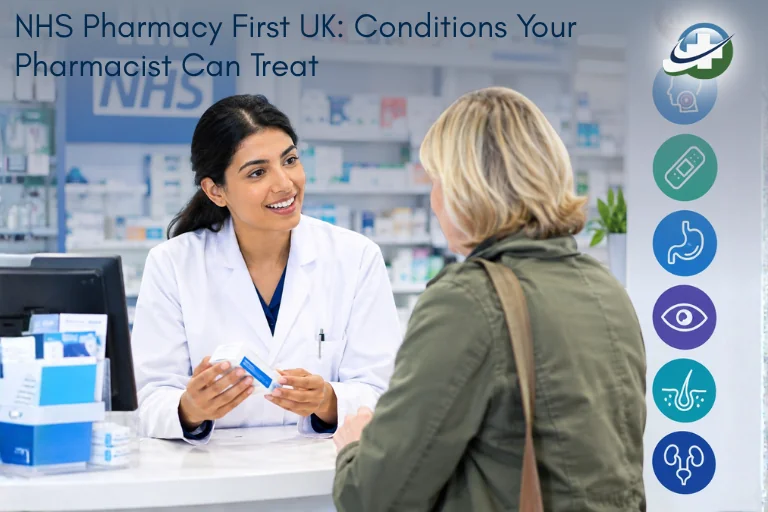
NHS Pharmacy First UK is a service that lets community pharmacists treat a set list of common conditions directly without needing a GP appointment first. Run through participating pharmacies across England, it’s designed to give patients faster access to advice, and where appropriate, prescription-only treatment, for conditions that don’t need a doctor’s diagnosis.
If you’ve never heard of it, you’re not alone many people still default to booking a GP appointment for things their local pharmacist can now treat on the spot.
What Is NHS Pharmacy First?
NHS Pharmacy First launched to ease pressure on GP surgeries by allowing trained pharmacists to assess and treat a defined list of common conditions, including prescribing certain medicines where clinically appropriate all without a prior GP referral.
Unlike a standard over-the-counter conversation at the counter, an NHS Pharmacy First consultation is a formal clinical assessment, carried out in a private consultation room, following the same clinical pathways a GP would use for these specific conditions. If your symptoms match one of the qualifying conditions, your pharmacist can examine you, offer advice, and issue a prescription if needed all in the same visit.
You can read more about the full range of services on our NHS Services page, or find official guidance directly from the NHS website.
Which Conditions Can a Pharmacist Treat Under Pharmacy First?
The scheme currently covers seven core conditions. Here’s a quick, scannable breakdown of what’s included:
- Sinusitis – Pharmacists can assess sinus infection symptoms and prescribe treatment for adults and children over 12.
- Sore throat – Includes assessment for bacterial infection and antibiotic prescribing where appropriate, for patients aged 5 and over.
- Earache – Available for children aged 1 to 17, covering suspected middle ear infections.
- Infected insect bites – Pharmacists can treat infected bites, including those showing signs of spreading infection, for patients aged 1 and over.
- Impetigo – A bacterial skin infection, treatable under the scheme for patients aged 1 and over.
- Shingles – Treatment is available for adults aged 18 and over presenting with typical shingles symptoms.
- Uncomplicated urinary tract infections (UTIs) – Available for women aged 16 to 64 with typical UTI symptoms and no complicating factors.
Skin and Bite-Related Conditions
Skin infections make up a significant share of these consultations. Infected insect bites and impetigo, in particular, often worsen quickly without treatment, which is why same-day pharmacist access matters. You can read more detail on eligibility and symptoms on our infected skin bites, impetigo, and shingles pages.
Urinary and Women’s Health Conditions
Uncomplicated UTIs are one of the most commonly treated conditions under the scheme, largely because symptoms are usually recognisable and treatment guidelines are well-established. Full eligibility criteria and symptom guidance are available on our uncomplicated UTIs page.
How Is This Different From a Regular Pharmacy Visit?
A standard pharmacy visit typically involves buying over-the-counter medicine after a brief chat at the counter, based on symptoms you describe yourself. A consultation under this scheme is a step up from this it’s a structured clinical assessment, conducted privately, using the same referral pathways a GP would follow for that specific condition.
The key differences are:
- Clinical assessment, not just a product recommendation
- Prescription-only medicines can be issued directly, where appropriate
- Documentation is shared with your GP practice, keeping your medical record up to date
- No self-referral limit you don’t need to have tried anything else first
This distinction matters because it means the scheme isn’t a replacement for pharmacy advice generally it’s an entirely separate, more clinically thorough pathway for a specific list of conditions.
Do You Need an Appointment for Pharmacy First?
In most cases, no formal appointment is required many of these consultations can be arranged as a walk-in, subject to pharmacist availability. That said, calling ahead is a good idea if you want to check the pharmacist is free, or if your GP practice has referred you directly.
You can also be referred into the scheme by:
- Your GP practice, if they identify your condition as suitable
- NHS 111, either online or by phone
- A walk-in visit to a participating pharmacy, like Pottery Road Pharmacy
If you’re used to booking ahead for healthcare appointments, our guide on the difference between a walk-in pharmacy visit and a GP appointment explains how the two pathways compare in practice.
What Happens if Your Pharmacist Can’t Treat You?
Not every case of a qualifying condition is suitable for pharmacist treatment. If your symptoms fall outside the standard clinical pathway for example, if you’re pregnant, have certain underlying health conditions, or your symptoms suggest something more serious your pharmacist will refer you onward, usually to your GP or, in urgent cases, to emergency care.
This safety-first approach is built into the model: pharmacists are trained to recognise when a condition needs a different level of care, and referral is a normal, expected part of the service rather than a failure of it.
Why This Matters During Busy GP Periods
GP appointment availability fluctuates, and common conditions like sore throats, earache, and UTIs often can’t wait for the next available slot. This service gives patients a faster route to clinical treatment during exactly these periods no lengthy phone queues, no multi-day wait, and often same-day access at your local pharmacy.
For Reading residents, this makes a local, walk-in-friendly pharmacy a genuinely useful first stop for the conditions covered by the scheme. If you’re new to using a pharmacy this way, our post on walk-in pharmacy services in Reading covers what to expect from your first visit.
Frequently Asked Questions
Is NHS Pharmacy First free?
Yes. Pharmacy First consultations are free on the NHS, in the same way a GP appointment would be. Standard prescription charges may still apply if you’re issued medication, unless you’re exempt.
Do I need to be registered with this pharmacy to use Pharmacy First?
No. You don’t need to be registered with a specific pharmacy to access this service you can walk into any participating pharmacy, including Pottery Road Pharmacy, regardless of where your GP is registered.
Can Pharmacy First prescribe treatment on the spot?
Yes, for the seven qualifying conditions, pharmacists trained under the scheme can issue prescription-only medicines directly during your consultation, without needing to send you to a GP first.
What if my condition isn’t covered under Pharmacy First?
If your symptoms don’t match one of the seven qualifying conditions, your pharmacist can still offer general advice and over-the-counter guidance, and will direct you to book a GP appointment or contact NHS 111 if further assessment is needed.
Find Out if Pharmacy First Can Treat You Today
If you’re dealing with a sore throat, earache, infected bite, or another condition covered by the scheme, there’s no need to wait for a GP appointment. Walk into Pottery Road Pharmacy or call ahead to check availability, and one of our pharmacists can assess whether this service is right for you.
Walk in or call today to find out if your condition qualifies for Pharmacy First treatment.